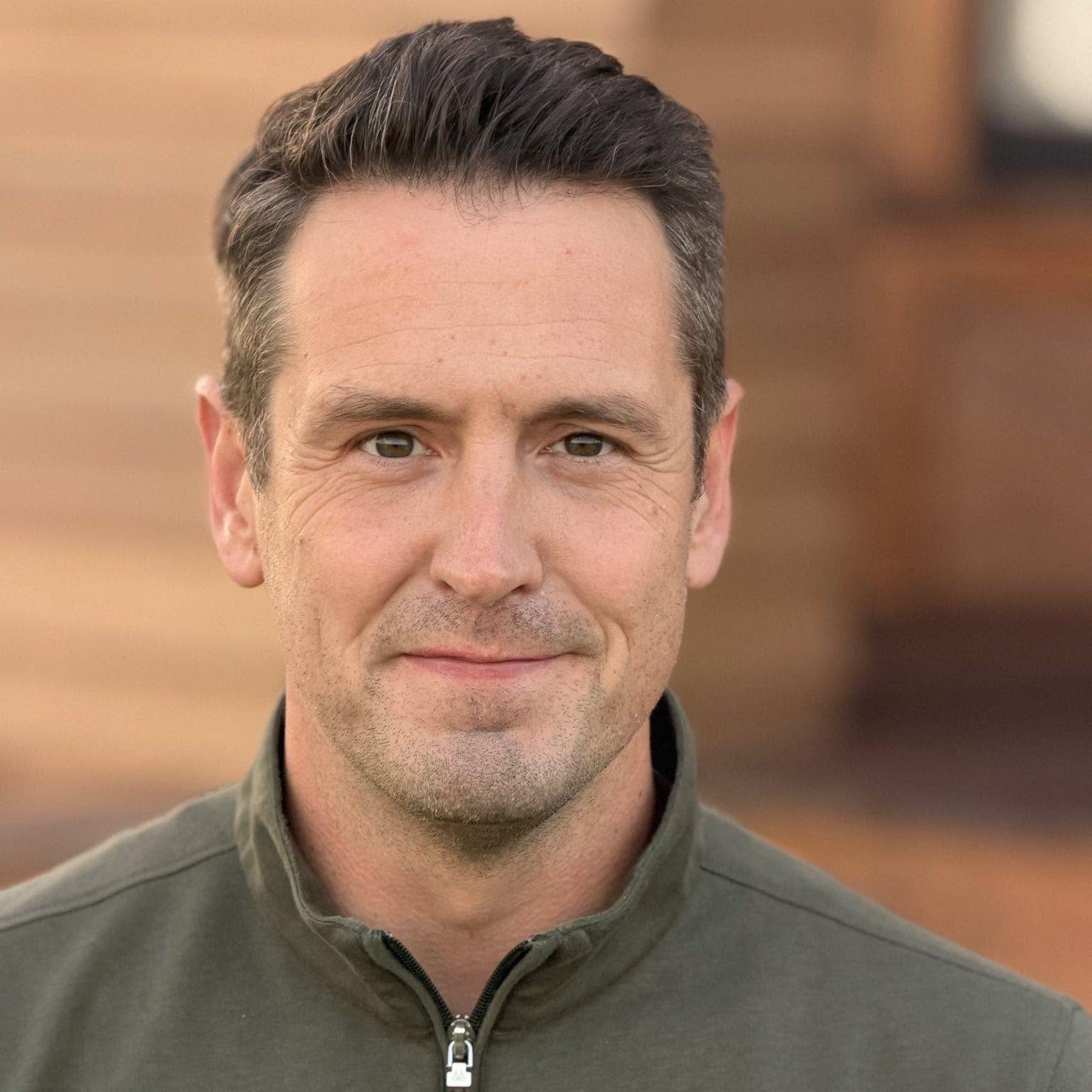
Rob Sand and Zach Lahn focused on schools, taxes and government spending in their second debate. Here’s how they divided the time, where their plans differed and how their claims hold up.
Lahn spoke for about 25 minutes and Sand for about 23 minutes. Lahn accounted for 52% of their combined speaking time, compared with Sand's 48%.
Estimated share of candidate speaking time
Rob Sand
Zach Lahn
Rob Sand: about 48%
Zach Lahn: about 52%
Candidate time only. Includes opening and closing statements; excludes moderators. Estimated from AI transcript timestamps.
Photos provided by Lahn for Governor · Photos provided by Rob Sand for Iowa
Candidate
Estimated speaking time
Share of candidate time
Transcript words
Rob Sand
About 23 minutes
48%
4,709
Zach Lahn
About 25 minutes
52%
5,769
Their longest uninterrupted answers were Lahn's initial school-funding answer, about 3 minutes, 47 seconds, and Sand's government-waste answer, about 3 minutes, 14 seconds.
Opening and closing statements were limited to one minute. Most answers had no fixed time limit.
The words they returned to
Tap a word to compare how often each candidate used it.
Rob Sand
Democrat
Photos provided by Rob Sand for Iowa
Zach Lahn
Republican
Photos provided by Lahn for Governor
Word counts
Word sizes reflect mentions per 1,000 words. Common filler and candidate names are excluded; selected related forms are grouped.
Lahn used more words overall. These selected terms show how often each candidate returned to schools, taxes and government.
Term
Sand
Lahn
School
12
25
Tax
13
19
Children
8
18
Government
8
14
Public
15
11
Teacher
5
10
Budget
8
2
Counts combine singular and plural forms; children includes kids.
Where their plans differed
Issue
Sand
Lahn
Public-school funding
Promised a 5% increase in his first year.
Supported targeted spending on innovation and student support; gave no percentage.
Private-school accounts
Would restore an income limit.
Supported continued access to education savings accounts.
School food
Supported universal breakfast and lunch and more local food.
Set a long-term goal of sourcing 80% of school food in Iowa.
Property taxes
Emphasized efficiency through mandatory participation in the PIE program.
Sought eventual elimination for primary homes; proposed a public spending ledger to identify savings.
Data centers
Opposed tax incentives and secrecy agreements with public officials.
Opposed tax incentives; called for stronger conditions on power, water and community benefits.
University hiring
Warned that ending H-1B hiring could leave jobs unfilled.
Supported ending H-1B hiring at public universities and institutions.
Checking the claims
A real beef requirement, applied too broadly
Lahn • 19:59–20:15; clarification 22:40–22:54 • Finding: Misleading as stated
Lahn said a supplier must be able to deliver 42,000 pounds of ground beef at a time for Iowa schools to receive USDA school food support. When a moderator described that as a daily requirement, Lahn clarified that the requirement applied to each delivery.
The number is real. USDA's ground-beef purchasing specifications set a 42,000-pound delivery unit for coarse ground beef in that procurement channel. That helps explain his concern about small suppliers competing for federal bulk contracts.
But USDA's February 2026 local-beef guidance explicitly identifies two purchasing routes: meal-program cash reimbursement and USDA Foods entitlement dollars. It also permits formal and informal procurement methods and geographic preferences. Local beef counts toward meal requirements in the same way as other beef.
Schools can buy smaller quantities of local beef and receive meal reimbursement. Lahn applied a bulk-contract requirement too broadly.
The budget gap is real; the fund withdrawal is a different number
Sand • 7:01–7:48 • Finding: Supported in substance, with context
Sand described an annual budget gap of roughly $1.3 billion to $1.4 billion and said the Taxpayer Relief Fund was being depleted at that rate.
The Legislative Services Agency's August budget recap lists $9.645 billion in FY 2027 appropriations. Its March revenue estimate was $8.472 billion, with subsequent revenue adjustments of negative $67.1 million. Subtracting those adjusted annual receipts from appropriations produces a gap of about $1.24 billion before accounting for other budget mechanics.
The same recap lists a $617.8 million FY 2027 transfer from the Taxpayer Relief Fund and a $1.488 billion surplus carryforward. These are different sources of money. Sand's central warning—that spending exceeds annual revenue and accumulated balances help bridge the gap—is supported. Treating the whole gap as that year's withdrawal from the Taxpayer Relief Fund is imprecise.
Iowa balances its budget using annual revenue, prior balances and transfers. How long those balances last depends on future spending and revenue.
Both candidates need to name their education measures
Sand • 29:42–30:07; Lahn • 30:41–30:54 and 35:27–35:35 • Finding: Rankings need context
Sand said Iowa fell from fifth in 2018 to the bottom half. Lahn said Iowa had been first in 1992, then fell 27 places even as inflation-adjusted per-pupil spending increased 50%.
The Annie E. Casey Foundation's 2026 education index puts Iowa 27th. WalletHub ranks its school system 21st and Nebraska 11th. Sand's bottom-half description depends on the ranking.
Contemporaneous reporting of U.S. News's 2018 rankings identifies Iowa as fifth in the broader education category, which includes higher education. That cannot automatically be compared with a current K–12-only rank. U.S. News began its Best States rankings in 2017, so it cannot provide a continuous 1992-to-present series for Lahn's comparison.
Iowa historically led on particular tests. Verifying either candidate's full comparison requires matching the ranking, category and years.
Lahn's exact 50% spending figure remains unverified. He did not identify the expenditure measure, endpoint or inflation index. Those details matter because state formula funding, operating costs and total spending measure different things.
Sand said Iowa raised starting pay to $50,000 but paid for it by cutting salary steps for more experienced teachers.
State implementation guidance describes additional Teacher Salary Supplement funding. It says 189 districts received $22.35 million beyond the cost of reaching the initial minimums, money available to address pay compression. It also identifies other district funding flexibility.
Higher minimums can narrow the pay gap between new and experienced teachers. Sand's more specific claim—that cutting experience steps financed the increase—needs evidence from the law or district salary agreements.
Lahn's data-center comparison has substantial support
Lahn • 46:28–46:49 • Finding: Central figures supported
Lahn described a nearby data center receiving more than half a billion dollars in property tax breaks while being required to create 30 long-term jobs.
Cedar Rapids' QTS project summary estimates $529 million in rebates and lists a minimum of 15 jobs per phase—30 for the initial and next phases. Those central figures support his criticism. The minimum does not establish how many people the completed campus will eventually employ, and temporary construction work is separate from permanent employment.
The rebates are conditional and would be paid over time. The city identifies the QTS campus as 612 acres, whereas Lahn said 1,400 acres. This review has not established whether his acreage refers to a larger development area or a different project. It has not verified his topsoil-removal description.
Sand said universal breakfast and lunch would attract additional federal dollars and mean Iowans pay less.
Federal reimbursement can help finance universal meals, and eliminating meal charges would lower participating families' direct bills. But under the Community Eligibility Provision, federal assistance does not necessarily cover all operating costs. USDA requires nonfederal money to cover any remaining gap; it also says no such contribution is required when federal support covers the operating costs.
Sand provided no state cost estimate or reimbursement calculation. Families would save on meal charges; Iowa's total public cost remains an open question.
Sand credited Iowa with being the first state to establish merit-based judicial selection. Missouri adopted its nonpartisan selection plan in 1940. Iowa voters approved merit selection and retention elections in 1962.
Iowa's redistricting system uses nonpartisan staff and legislative approval
Sand • 50:29–50:37 • Finding: Inaccurate description; national-first claim not established
Sand said Iowa was the first state to create an independent redistricting commission. Iowa's system gives map-drawing duties to nonpartisan legislative staff. A Temporary Redistricting Advisory Commission assists and holds hearings; the Legislature votes on the plans.
Iowa adopted its current nonpartisan approach in 1980. It restricts the use of political information, including incumbents' addresses and prior election results. Those are real protections against partisan mapmaking. But an advisory commission in this structure is different from an independent commission empowered to enact maps. Sand's wording obscures that distinction and does not establish his asserted national first.
Sand • Opening, government-waste discussion and closing • Finding: Supported
Sand repeatedly said lawmakers made it harder for the state auditor to do the job. The 2023 law added restrictions on access to categories of personal and sensitive records. It also directed executive-branch interagency disputes to arbitration rather than litigation, with one arbitrator appointed by each side and a third by the governor.
Exceptions allow access required by audit standards or other regulations and in cases of suspected theft or embezzlement. The law supports Sand's claim that lawmakers restricted the office's powers.
Sand committed to a 5% school-aid increase in his first year and said he could not promise the same for year two. He acknowledged that cannabis taxes and ending data-center tax breaks alone would not balance the budget. He supplied no fiscal breakdown showing that the full package would cover the increase.
Lahn did not provide a school-aid percentage after the moderator asked twice. He acknowledged that he had not released the exact mechanism for eliminating primary-residence property taxes. He mentioned a sales-tax increase floated by others and explicitly said it was not his proposal.
Both candidates opposed data-center tax incentives. Ending local property-tax rebates and ending state sales-tax exemptions are distinct actions with different budget effects. Only the state revenue would directly support the state General Fund.
How we counted
Speaking-time estimates use Otter's speaker timestamps, checked against the YouTube transcript. They include openings and closings and exclude moderators. The moderator's follow-up within Lahn's school-funding answer was separated. Word counts use the corrected Otter text. Timestamps in the fact checks follow YouTube. Automated transcription and overlapping speech can affect the totals.